

When home services and trade operations prepare for ownership transitions, mergers, or capital expansion, determining the true value of the business and appraising home service contracting assets become critical priorities. Unlike technology firms or consulting agencies, whose valuations are driven almost entirely by intellectual property and recurring software contracts, contracting operations are anchored by a substantial physical footprint. An HVAC, plumbing, or electrical contractor relies on a complex mix of tangible assets, specialized tooling, vehicle fleets, and recurring customer contracts to generate revenue.
A formal business appraisal is essential to translate this diverse operational infrastructure into a credible dollar figure. Buyers, lenders, and sellers need to know exactly how much the physical inventory, service fleet, and customer goodwill are worth under current market conditions. Relying on rule-of-thumb formulas or tax depreciation schedules can lead to valuation inaccuracies, either underpricing the business or overpricing it relative to the market. Understanding the valuation methodology for trade infrastructure is an important step toward a successful transaction.
Understanding the Fundamentals of Trade Infrastructure Appraisal
To determine the value of a home services business, appraisers look at two primary categories: tangible assets and intangible assets. Tangible assets include the physical items owned by the company, such as diagnostic instruments, warehouse storage systems, parts inventories, and the service fleet. Intangible assets represent the non-physical drivers of revenue, such as customer contracts, maintenance agreements, brand recognition, trained staff, and operating licenses.
In the formal valuation process, appraisers use three primary approaches: the asset-based approach, the income approach, and the market approach. For trade operations, these approaches are often blended to reflect the true earning power of the company’s physical infrastructure. The asset-based approach calculates the net value of all assets minus liabilities, which is particularly useful for capital-heavy firms. The income approach focuses on the present value of future cash flows generated by those assets, while the market approach compares the business to similar companies that have sold recently.
When owners seek to exit, merge, or secure financing, they typically work with valuation professionals who specialize in appraising home service contracting assets to establish a credible, market-supported value for their enterprise. This specialized appraisal ensures that the physical infrastructure is valued not just as scrap metal or used equipment, but as a functioning system that generates predictable cash flow.
Valuing Physical Tangible Assets and Specialty Tooling
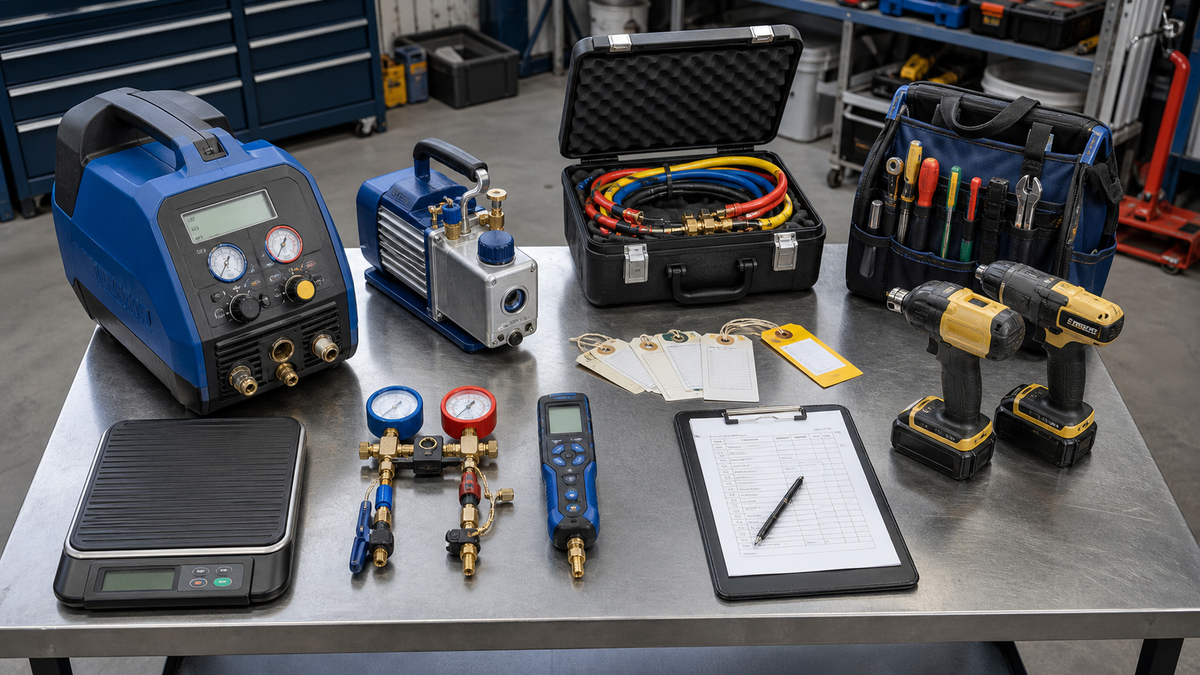
The physical tools of the trade represent a major portion of a contracting firm’s balance sheet. In an HVAC business, these assets range from hand tools and digital manifolds used by individual technicians to expensive warehouse equipment, recovery units, and sheet metal fabrication machinery. During an appraisal, these items must be inventoried and evaluated based on their physical condition, age, and remaining useful life.
Appraisers typically evaluate physical tools using two standards of value: Fair Market Value (FMV) and Orderly Liquidation Value (OLV). Fair Market Value assumes the equipment is sold in its current condition within an open market where both buyer and seller are fully informed and under no pressure to act. Orderly Liquidation Value assumes a forced sale over a reasonable period, which is typically lower than FMV. Appraisers also apply physical and technological obsolescence factors, as older diagnostic tools may be replaced by newer digital technologies that improve field efficiency.
Specialty tools used for niche service lines also command unique valuations. For instance, businesses that have invested in subgrade remediation or crawl space services can compare their assets’ replacement costs to standard industry pricing models to contextualize the value of their specialized tooling. Performing regular essential equipment auditing for HVAC contractors alongside keeping detailed maintenance records and calibration logs can significantly boost these assets’ appraised value, as it proves they have been well-maintained and are ready for field use.
Appraising Service Fleets and Specialized Work Vehicles
For most home service contractors, their service fleet represents their largest tangible investment. A fleet of well-equipped vans acts as a mobile billboard and a rolling warehouse. However, appraising a vehicle fleet is complex because commercial trucks depreciate quickly and are subject to heavy wear and tear.
To determine fleet value, appraisers review detailed vehicle logs, mileage, service histories, and physical condition reports. They also look at custom vehicle retrofitting, such as heavy-duty shelving, ladder racks, and custom wraps. While a generic van has a standard market value based on guides like NADA or Black Book, a fully outfitted service van has a higher value-in-use for a buyer who plans to keep the business running without interruption.
Appraisers must adjust their valuations if the fleet is leased rather than owned. Leased vehicles are not counted as assets on the balance sheet, though the lease agreements represent ongoing liabilities that must be factored into the overall cash flow analysis. Having complete preventative maintenance logs and clean driving records for the fleet reduces perceived risk and supports a higher valuation for the vehicle asset class.
Valuation of Intangible Assets and Customer Contracts

While physical tools and trucks are necessary to perform the work, the true value of a business is its ability to generate recurring revenue. In the home services sector, this is driven by intangible assets, specifically customer contracts and service agreements. Homeowners and commercial clients who sign up for annual maintenance plans are highly valuable because they represent locked-in revenue and regular touchpoints for future system replacements.
Appraisers value these recurring service agreements using the income approach, calculating the discounted cash flow (DCF) generated by the maintenance plans over their expected lifespan. They also apply an attrition rate, which estimates how many customers will cancel their agreements or move out of the service area each year. A business with a low customer churn rate and a high percentage of recurring revenue typically commands a higher valuation multiple than a firm that relies entirely on one-off emergency service calls.
Specialized service agreements related to risk mitigation also carry substantial intangible value. For instance, service contracts tied to property inspections or those involved in evaluating facility hazards in commercial real estate are highly valued because they address critical environmental and operational risk reviews. These specialty agreements often involve multi-year commitments and deep customer loyalty that represent significant goodwill and intangible asset value. The brand’s reputation, local search engine rankings, and proprietary customer databases are also appraised as part of this goodwill, as they directly drive organic leads and lower marketing costs for the incoming owner.
Synthesizing Asset Appraisals into Business Valuation Reports
Once the appraiser has evaluated the tangible tools, fleet vehicles, and intangible contracts, they synthesize these findings into a comprehensive business valuation report. This document explains the methodology used, lists all assumptions made, and presents a clear, defensible range of values for the company.
A professional valuation report is a critical tool during negotiations. If a seller can present a professional appraisal that details the value of their physical assets and recurring contracts, they are in a much stronger position to defend their asking price. Lenders also rely on these reports when reviewing loan applications from buyers, as the SBA (Small Business Administration) and commercial banks may require independent valuations depending on transaction sizes or specific lender policies.
Ultimately, valuing trade infrastructure is about understanding how physical assets and intangible relationships work together to produce consistent profit. By auditing equipment inventories, keeping detailed fleet logs, and building strong recurring revenue programs, home service contractors can maximize their asset values and position their businesses for a successful, high-value transfer.
Sources
- American Society of Appraisers. (2020). Valuing Machinery and Equipment: The Fundamentals of Appraising Machinery and Technical Assets. 4th Edition. American Society of Appraisers. https://www.appraisers.org/disciplines/machinery-technical-specialties
- IRS. (2020). IRM 4.48.4: Business Valuation Guidelines. Internal Revenue Service. https://www.irs.gov/irm/part4/irm_04-048-004


0 Comments